-
+86-551-62240026
- leonnn410@gmail.com

+86-551-62240026
2026-09-04
Hyperspectral imaging, originally used in the mid-1980s for remote sensing, has expanded into numerous research fields over the past two decades, especially in agriculture and food science, where it is used to collect additional data on the visual and chemical properties of objects under study. Hyperspectral imaging combines traditional imaging with spectral technologies such as infrared spectroscopy, Raman spectroscopy, and fluorescence to form a three-dimensional data structure called a hypercube, which integrates two-dimensional digital imaging and the spectral dimension of the data. Each pixel is associated with a spectrum reflecting the optical characteristics of the region it represents; although it is influenced by neighboring pixels, the spectrum can serve as a unique feature for identifying substances. In the field of quality assessment of fruits, vegetables and mushrooms, hyperspectral imaging faces challenges such as data availability and model reliability. Existing research is mostly lacking in practical applications, and attention needs to be paid to reproducibility and translation of research parameters into industrial parameters to achieve non-destructive quality assessment, reduce food waste and ensure food safety.
The integration of artificial intelligence and hyperspectral imaging is critical. Artificial intelligence algorithms, mainly machine learning and deep learning techniques, are capable of efficiently processing high-dimensional and large-scale hyperspectral imaging data, providing accurate feature extraction and classification. They demonstrate outstanding performance in processing large data sets, denoising, real-time analysis and improving task accuracy, making them invaluable for hyperspectral data-dependent applications such as agriculture and remote sensing. As artificial intelligence technology advances, its integration with hyperspectral imaging will become even tighter, real-time processing will be realized, and combination with new technologies will expand the scope of application and stimulate industry innovation. Despite the challenges associated with data and computing, the outlook remains optimistic. This review will discuss in detail the key role of artificial intelligence in the application of hyperspectral imaging, existing problems and prospects for future development.
The mechanism of hyperspectral imaging and related problems
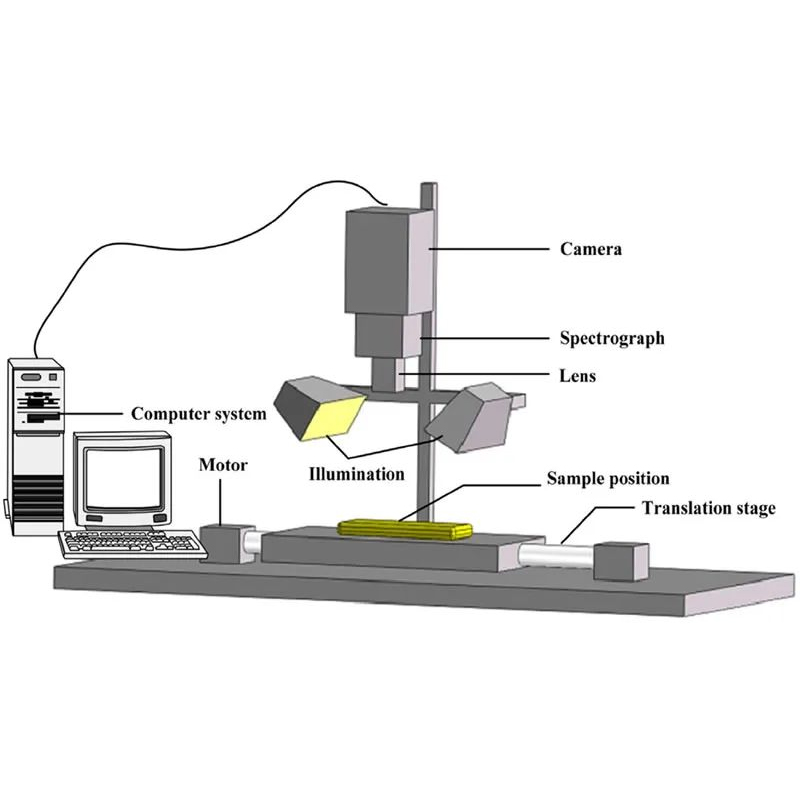
Hyperspectral imaging works by capturing and processing spectral information, overcoming the limitations of traditional imaging, which only collects data in a few spectral bands. The process begins by illuminating the target scene with a light source. After light interacts with materials in a scene, a hyperspectral sensor, using optical elements such as a prism or a diffraction grating, decomposes the collected light into different wavelengths, then the sensor array records the light intensity at each wavelength, thus forming a hyperspectral data cube with rich spectral information, spanning two spatial dimensions and one spectral dimension. Data collection methods include point scanning, line scanning, spectral scanning and snapshot cameras. After data collection, calibration is required to correct for sensor response, lighting, and atmospheric effects, followed by advanced data processing techniques such as spectral decomposition, classification, feature extraction, and dimensionality reduction.
Hyperspectral imaging data is characterized by high dimensionality and complexity: each pixel contains hundreds of spectral bands, resulting in huge data sets, high computational and storage requirements, and the problem of data redundancy. At the same time, the data is subject to noise interference and sensitive to environmental conditions, which requires complex pre-processing techniques such as noise reduction, atmospheric correction and calibration. Artificial intelligence can solve these problems: its machine learning and deep learning technologies are excellent at processing complex data, can automatically learn spectral features, reducing the amount of manual feature construction, and have significant advantages in multi-dimensional data processing, denoising, real-time analysis and improving task accuracy, playing an important role in hyperspectral data analysis.

Figure 1. Diagram of the main components of a hyperspectral imaging system
Types of Hyperspectral Imaging
Spot scanning: one pixel is captured at a time, the camera gradually builds an image as it scans the sample, each pixel contains complete spectral information, the spectral resolution is high, but image acquisition takes a long time, which is not suitable for fast data acquisition scenarios; Typically used for laboratory spectral analysis.
Line Scan: Line-by-line measurement of a continuous spectrum, widely used in industrial quality control and monitoring. Despite light loss due to the spectrometer entrance slit, a balance is achieved between speed and spectral resolution, which is suitable for real-time monitoring and analysis.
Fourier transform spectroscopy: can measure a continuous spectrum, combines a monochromatic image sensor and an interferometer, the light output is higher than that of push-pull scanning systems, the efficiency and accuracy of spectral data collection is high, suitable for applications with high sensitivity and accuracy requirements, capable of operating in a wide range of wavelengths, widely used in areas such as chemical analysis.
Spectral scanning: allows you to collect all spatial information at certain wavelengths, processing is carried out sequentially for each wavelength. Although collecting a single image is relatively fast, the overall process is slowed down by the need to switch wavelengths. Plays a significant role in applications that require high spatial resolution at specific wavelengths, such as fluorescence microscopy, and can also be optimized to focus on specific areas of interest.
Hyperspectral Snapshot Cameras: Capable of capturing hyperspectral video, suitable for capturing moving objects, data collection is fast and efficient, but spectral and spatial resolution is limited compared to other technologies. They have important applications in real-time hyperspectral imaging, such as medical diagnostics.
High-resolution hyperspectral imaging is critical for detecting spectral changes in complex targets, but the high cost of existing high-resolution equipment limits its application and dissemination. The low-cost device developed by Stewart and other researchers opens a new way to solve this problem and shows good performance in mineralogical environmental monitoring.
Table 1. Characteristics of scanning methods used in hyperspectral imaging.

Synergistic interaction between artificial intelligence and hyperspectral imaging
Hyperspectral imaging contains hundreds of spectral bands, the data is high-dimensional, and there are problems of redundancy, noise, and the “curse of dimensionality” that traditional analysis methods find difficult to cope with. Artificial intelligence algorithms, especially machine learning and deep learning models, can effectively solve these problems.
Supervised learning algorithms use labeled data to train classification or analysis models, for example, support vector machines are suitable for classifying high-dimensional data and small training sets; random forests are highly robust and capable of processing noisy data; the k-nearest neighbors method performs classification based on the proximity of the pixel spectrum to the labeled data; neural networks such as multilayer perceptrons can be used for pixel-by-pixel classification.
Unsupervised learning algorithms are capable of discovering hidden patterns in data without predefined labels, such as k-means clustering, principal component analysis, and others; Convolutional neural networks and recurrent neural networks among neural networks can learn representations of complex data; Reinforcement learning algorithms are suitable for dynamic environments; independent component analysis is used for blind source separation; Autoencoders are used for unsupervised feature extraction and dimensionality reduction. There are also new methods, such as DiffSpectralNet, that integrate various technologies to improve classification performance.
Deep learning technologies use deep neural networks to automatically learn features, avoiding manual feature construction. Generative adversarial networks can be used for data augmentation and other purposes. In convolutional neural networks, convolutional layers extract features through connections of local receptive fields, and when combined with technologies such as pooling layers, they improve the generalization ability of the model, demonstrating outstanding results when processing complex high-dimensional data.
Spectral decomposition often uses non-negative matrix factorization and sparse coding techniques. Hybrid models that combine spatial and spectral information improve performance on tasks such as classification, such as spatial-spectral convolutional neural networks and graph convolutional networks. Natural language processing algorithms also help artificial intelligence understand and generate language, facilitating the development of intelligent tasks in many fields.
In practical applications, AI-enhanced hyperspectral cameras can improve signal processing speed and noise immunity, providing accurate spectral reconstruction. AI-driven super-resolution algorithms can enhance the spatial resolution of images, facilitating precise mapping and detection. In classification tasks, machine learning and deep learning technologies are capable of processing multidimensional spectral data, implementing the classification of materials or objects. AI algorithms can retain key information in denoising, fill in missing parts in image reconstruction, and use spectral information to improve accuracy in object detection and image segmentation, playing an important role in various fields.

Figure 3. a) Simplified diagram of a hyperspectral random wideband encoding camera based on deep learning: the camera operates in active mode (top) or passive mode (bottom) depending on the position of the spectral encoding. b) Overview of deep neural network-based spectral reconstruction: A deep neural network processes raw monochromatic camera data to generate a reconstructed 3D hyperspectral data cube. c, d) Spectral profiles of a narrow-band laser beam: in case c, the deep neural network is trained on “accurate” data, and in case d, on “general” data. e) Spectral profiles of two peaks at wavelengths 598.0 nm and 603.2 nm, the distance between the peaks is shown in black.
Table 2. Characteristics of various algorithms used in the interaction of artificial intelligence and hyperspectral imaging.

Application of synergistic interaction of artificial intelligence and hyperspectral imaging in agriculture
Crop growth monitoring: Using artificial intelligence and hyperspectral imaging, hyperspectral images of crops at different growth stages can be accurately analyzed. By recognizing subtle changes in the spectral characteristics of crops, their health status is determined, for example, whether they have been affected by pests and diseases, whether there are nutritional deficiencies, and so on. For example, deep learning models can analyze the spectral reflectance of crop leaves in hyperspectral images, distinguishing between healthy and diseased leaves, helping farmers take proactive preventative and control measures to improve crop yields and quality.
Assessing the quality of agricultural products: non-destructive testing of fruits, vegetables and other agricultural products is performed. Based on its unique spectral fingerprints, combined with artificial intelligence algorithms, indicators such as ripeness, sweetness and internal quality of agricultural products are accurately determined, which facilitates sorting, selection and accurate marketing of agricultural products.

Figure 4. Artificial intelligence and hyperspectral imaging used for food quality analysis
Remote sensing area
Land cover classification and monitoring: hyperspectral imaging of large areas of the earth's surface is possible. Artificial intelligence algorithms process the data to accurately distinguish between different types of land cover, such as forests, grasslands, croplands, water bodies, urban structures, etc., and allow real-time tracking of land use changes such as urban expansion, deforestation, and wetland decline, providing reliable information support for land management and environmental protection.
Mineral resource exploration: Because different minerals have specific spectral absorption and reflectance characteristics, the combination of artificial intelligence and hyperspectral imaging technology can identify potential mineral distribution zones in remote sensing imagery, increasing exploration efficiency and reducing exploration costs.
Scope of environmental monitoring
Water pollution monitoring: By analyzing hyperspectral data of water bodies, artificial intelligence is able to determine the types and concentrations of pollutants in water, for example, recognizing whether the content of heavy metals in water exceeds established standards, the presence of organic pollutants, and so on, providing dynamic monitoring of the quality of the aquatic environment.

Figure 5. Remote hyperspectral imaging system mounted on an unmanned aerial vehicle called a robotic jellyfish, which can be equipped with a net to collect large plastics or microplastics from various water surfaces.
Atmospheric Composition Analysis: Hyperspectral imaging captures the spectral signatures of various gas molecules in the atmosphere, and applies artificial intelligence algorithms to determine the content and distribution of greenhouse gases, pollutants and other components in the atmosphere, which helps combat air pollution and climate change research.
Medical field
Disease diagnosis: For example, in the field of skin disease diagnosis, hyperspectral imaging is used to obtain spectral images of affected areas of the skin, artificial intelligence models analyze these images, helping doctors determine the type and severity of the lesion, and so on, increasing the accuracy and efficiency of diagnosis.

Рисунок 9. Схема периферической гемодинамики здорового взрослого человека в состоянии покоя, демонстрирующая оксигемоглобин, гемоглобин и сатурацию кислорода в крови.
Гистопатологический анализ: выполняется гиперспектральная визуализация патологических срезов, на основе алгоритмов искусственного интеллекта извлекается заложенная в них спектральная информация, что помогает распознавать микроструктурные особенности, такие как раковые клетки и поражённые ткани, предоставляя справочную основу для точного лечения заболеваний.
Промышленная область
Контроль качества продукции: в обрабатывающей промышленности выполняется гиперспектральная визуализация продукции на производственной линии, алгоритмы искусственного интеллекта позволяют быстро обнаруживать дефекты поверхности продукции, внутренние структурные недостатки и другие проблемы качества, обеспечивая автоматизированный и высокоточный контроль качества.
Идентификация и анализ материалов: для различных промышленных материалов гиперспектральная визуализация в сочетании с искусственным интеллектом позволяет быстро и точно определять вид и состав материалов, а также оценивать соответствие их характеристик установленным требованиям, что облегчает отбор сырья и контроль качества продукции.
Синергетическое взаимодействие искусственного интеллекта и гиперспектральной визуализации представляет собой значительный прогресс в области обработки данных и технологий идентификации материалов. По мере непрерывного развития технологий их пересечение способно стимулировать дальнейшие инновации, постоянно расширяя сферу их применения в научных исследованиях и практических сценариях. Будущее данного синергетического взаимодействия обладает потенциалом революционного преобразования многих отраслей, позволяет раздвигать границы существующих технологий, предоставляя точные, эффективные и универсальные решения, недостижимые традиционными методами, и открывая для различных отраслей совершенно новые возможности развития и преобразований.